Showing posts with label B Period. Show all posts

Wednesday, March 24, 2010

Space Exploration of the 60's

by: Micaela and Lainey

With the idea that whoever controls the space exploration controls the technological race as well, many countries tried to discover more ways to accomplish tasks of sending people to the outer space.

The most common misconception however, is that most people also believe that once you get to the moon, you can merely sent an missile down to destroy other nations. Science, in present day tells us otherwise, and in fact it is more effective to send a missile down from an airplane in the sky than from a shuttle in the moon.
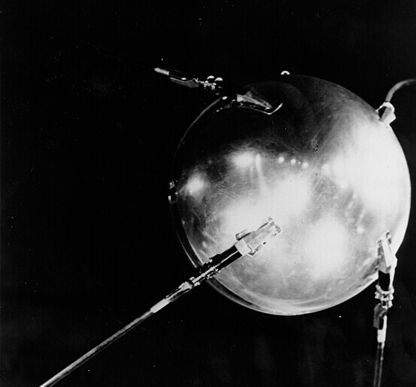


The competition was mostly between the United States and the Soviet Union. Once the Soviets released the Sputnik 1, in October 4, 1957, Americans felt fear and threat. Given the first artificial satellite launched to orbit the earth, Soviets were impressed by their accomplishments. Americans believe that it will come easy to the Soviets to overtake the country once they make the launch successful because it will enable them to get a hold of more advance and dangerous weapons.


A month later, USSR launched their second satellite, Sputnik 2. This satellite contained the first living organism to ever travel outer space. A dog named Laika, was used to test if the shuttle conditions were appropriate and sufficient to support a man on space. When Laika came back with no psychological damages, they were confident enough to send a man in space.

As the US launched its first successful satellite, the Explorer 1, the government gave way to more studies done in the space exploration field. The Eisenhower administration passed the National Defense Educational Act. This act allowed the government to spend more $1 billion for a wide range of reforms. Such including new school construction, fellowships and loans to encourage promising students to seek higher education, new efforts in vocational education to meet critical manpower shortages in the defense industry, and a host of other programs (1959).

On the other hand, Pres. Kennedy (1962) decided to start a program developing the space race. The goal of National Aeronautics and Space Administration (NASA) was to send the first man to walk the moon. However, they were not able to send a man outer space until four months after the launching of Sputnik 1.
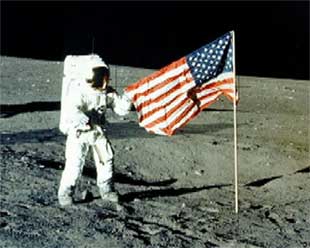


On July 20, 1969, US achieved their goal, and astronaut Neil Armstrong took his first steps in the moon. With this accomplishment, universities started to expand their space programs. These space programs spent a huge federal funding for research, and development which also gave rise to new industries and new technologies for the country.

Once again, the United States accomplishing this task of sending a man on space opened more opportunities to explore the world beyond the planet. The space race was a good way of proving the country's self worth and allowed for development of better technologies for the future.

Tuesday, March 2, 2010

Culture in the 1950's

by: Lainey and Micaela

Coming from World War II, the United States industry and manufacturing is still recovering from the traumatic experience that the war had put it through. However, the era of the 1950's is considered to be one of the turning points of American History due to the economic rise as well as its dominating industrialization. It allowed the recovery to be a fast and easy transition and made it able to progress.

During this time period, there are many inventions that have helped make America more efficient and known for its capabilities. Inventions such as automobiles helped transportation from city jobs to home much more convenient. In these times, suburban living made owning a car a necessity. jobs, churches synagogues schools stores and doctor's and dentists' offices were not walking distances it was essential to owning a car. Cars also added better ways for leisure by traveling and made people more connected with family from distant towns.


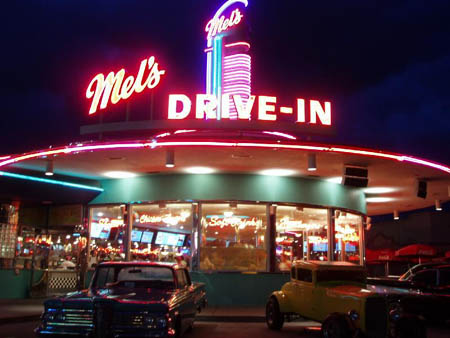
Also drive-ins and drive-thru's were very popular. families would go and watch a movie at the drive-in or go to drive-thru to get some fast food. waitresses would wear fancy uniforms or roller skates which was added to the fun of front seat dining.


In addition, there are also media improvement and the entertainment of the American citizen is now one of the sources of income for many businesses. More technological outlets for radios and movies are becoming even more popular to the average citizen. More and more people are accustomed to these areas of entertainment available to them. in 1948, there are 18500 movie theatres that draws in 90 million paid admissions for week. However, the invention of better television decreased the number of moviegoers. by 1954, 50% of movies were in color, and this helped attract more and more audience.

In the musical genre, there are more kinds of music being discovered. Music such as rock and roll were becoming popular with the generation and those such as; Elvis Presley, Chuck Berry and Bill Haley were becoming icons for the teens. They help involve more people in the musical department which helped boost the production of instruments. This started the era of musicians and other forms of artistic talents begins to surface.


Even though many other countries were trying hard to salvage what is left after the second World War, United States was able to turn their luck around and start the era of production and entertainment. This not only made America able to give itself a whole new meaning, but it also allowed the country to prosper.

Mother of the Moder Day Civil Rights Movement


Rosa Louise McCauley was born in Tuskegee, Alabama to a carpenter, James McCauley, and a teacher, Leona McCauley. At the age of 11, she went to a private school founded by liberal minded women in Montgomery. Her mother told her as she was growing up to "take advantage of the opportunities, no matter how few they were. As she grew up, she didn’t have any civil rights. She went to Alabama State Teachers College. After she graduated, she married Raymond Parks and settled down in Montgomery. Together they joined a chapter of the NAACP in 1943 to improve the African-American segregation in the south.
December 1, 1955 was a turning point for Mrs. Parks and for all historians. She took a seat in the front row of the "colored" section of a Montgomery bus. As the bus started to fill up, the driver ordered Mrs. Parks to leave the front of the bus so a white man could sit down not next to an African American. She refused to move. The bus driver threatened to call the police. Mrs. Parks replied, "You may do that."The word of her arrest spread quickly.
That incident led to the formation of the Montgomery Improvement Association, lead by Dr. Martin Luther King, a young pastor of the Dexter Avenue Baptist Church. The Association called for a boycott of the city owned bus company. It lasted 382 days and brought the Association a lot of attention. It proved to the world that one community could unite and organize a successful protest movement.
After the protest, A Supreme Court decision struck down on the Montgomery ordinance under which Mrs. Parks was fined. They also outlawed racial segregation on public transportation.
Mrs. Parks and her husband moved to Detroit, Michigan in 1957 where Mrs. Parks served on the staff of U.S. Representative John Conyers. In her honor, the Southern Christian Leadership Council established an annual Rosa Parks Award.
Her husband passed in 1977. She then founded the Rosa and Raymond Parks Institute for Self-Development. It sponsors an annual summer program for teenagers called Pathways to Freedom.
Mrs. Parks passed away in 2005 at the age of 92 in Detroit. Rosa Parks changed many lives and liberated many people.

Tuesday, February 23, 2010

Military Cover Up


by : Lainey B. and Micaela F.

In the wake of World War II, the Japanese attack on Pearl harbor drove the Americans to completely involve its nation in the new war. Because of the fear involved with more attacks from the Japanese, rumors spread that Japanese Americans were also involve in sabotaging mining coastal harbors and poisoning vegetables in the local markets. In response, President Franklin D. Roosevelt ordered a forced relocation and internment of the 120,000 Japanese Americans residing along the Pacific Coast of United States.


In 1942, these concentration camps were known as War Relocation Camps passed by the Executive Order 9066 that authorizes the military to form exclusion zones for any people not of Japanese descent to be excluded from. This keeps the Japanese in and everyone else out.

Because there were no specific charges filed against the Japanese Americans, they were forced to sell their homes, businesses and all their belonging for less than their true value. They were only allowed to carry the items that they can carry by hand. Because they have to leave their furniture at home, most were also not able to bring their mattresses and had to sleep on floors. During the winter, most people got sicks of the flu, and pneumonia and because of the lack of medical attention, many people died in the camp.

Japanese Americans lived in a prison like setting under constant guard. There were armed guards around the camp and barbed-wire-surrounded enclave with unpartitioned toilets, cots for beds, and a budget of 45 cents daily per capita for food rations. Because the Japanese were not told of their destination, most were unable to pack appropriate clothing which resulted in many unsanitary illness spread easily.

There were simple school like facilities in the camp that allowed them to learn some English and American studies, however, they were not told the reason for being confined in the camps.

Although the military action violated most of the rights of these people, such as the Five Amendment--due process, the court ruled that these government actions did not violate the people's rights because the restrictions were based on military necessity rather than on race--Japanese were said to post threats to the nation. Later on, in 1944, the Korematsu v. United States found that there were documents that showed that the army had lied to the court in the 1940's and the Japanese Americans had not posed any security threat. The conviction was overturned in 1984.

In 1988, the Congress passed a law ordering reparations to surviving Japanese Americans who've been detained in the concentration camps.