Wednesday, March 24, 2010

Era of Violence: Assassinations

On November 22nd, 1963, the presidnential aircraft Air-Force One landed in Dallas TX. The president had come to mend political "fences" with the members of the States Democrats. The president and his wife sat in the back of an open air limousine. As the car approached the state building, he was shot in the head. He was raced to a nearby hospital where he died.


As news spread of his death, one question was on everyones mind, "who killed shot Kennedy and why?" During the next for days, Lyndon Johnson took the oath of office on Air-Force One. Television audiences witnessed Dallas Police charge Lee Harvey Oswald as the murderer, because his palm print had been found on the rifle used to kill Kennedy. In 1963, the Warren Commission investigated the weird events that took place and concluded that Oswald had shot the president. Later though, a reinvestigation in 1979 concluded that there was another shooter. There have also been other investigations which have resulted in a wide variety of conclusions. Some people believe that it may have been an inside job by the CIA. They believe this because after reading the Warren report and other testimonies, people found contradictions. Those who feel that the CIA tried to cover it up point to the contradictions and claim that the information is purposely misleading which would be evidence of a cover up. They do not believe that the details are correct, so they feel that there may be some sort of cover up. Others believed that there was a magic bullet, because the trajectory of the bullet is a phenomenom that still can't be explained today. One other theory suggests that this was a plot by anti-castro Cubans. Some also believe that this was fueled by the Cold War and was fueled by the Soviet Union. This has been debated for many years and has been the cause of many conspiracy theories.

The day after the Assassination, the whole nation got work off to mourn the death of the President. President Kennedy was beloved by most Americans. Still today, Kennedy's killer is still debated today.


Connor and Cody


Tuesday, March 9, 2010

The Race in Space


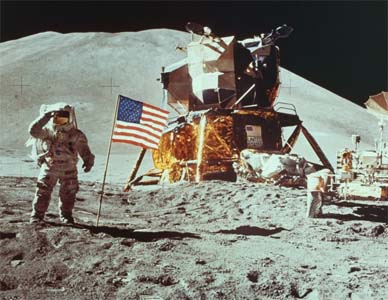
On July 20th, 1969, Niel Armstrong would take the first steps onto the moon. This was a monumental achievement, not only for the United States, but for humanity has a whole. Finally, we had reached our goal of interplanetary exploration, and although the moon is just one small step of many, it is a launching point for exploration in space.
These few steps on the moon were the result of more than seven years of diligent work. The whole situation began with the Soviet cosmonaut Yuri A. Gagarin, the first human in space. For years, Soviet Russia had been working on sending a man into space, and finally achieved this goal on April 12, 1961. Frightened by the possibility of the Soviets gaining an edge on us, President Kennedy vowed that America would be the first country with a man on the moon. In less than a month, the US also had a man travel into space. Following the creation of the National Aeronautics and Space Administration (NASA), the United States dedicated a lot of time and money in reaching its goal of having a man skip around on the moon. It would be more than seven years until this goal would be accomplished.
The impact of this historic event can still be felt today in our technology and in our schools. Most of our wireless technology stems from the use of satellites and super-orbital spacecraft, and there is endless possibility for technological and economic expansion among the stars. Also, following the massive federal funding for research and space development, many schools and universities expanded their science curriculum immensely. The steps of one man are followed by years of international cooperation, the growth of business and renewed excitement in the sciences in the schools of America.

-Holt Bowmer

Friday, March 5, 2010

women in wartime


After the attack of Pearl Harbor, many of the militaries’ ships and aircrafts were destroyed. But in order for the U.S. to have a fighting chance against Japanese they had to recreate the lost ships and aircrafts. This opened many jobs for the citizens. Soon after the military started drafting men, and even a sum of 5 million men volunteered. Because of the draft they was an extreme shortage of men left to work in the U.S. So the women had to step up and take their places.
As the government realized that they needed more people to work for the military, they had passed The Women’s Auxiliary Army Corps. This had allowed women to work for the military as long as they would not see the battlefield. In a short amount of time about 6 million women had joined the work force. By 1944, there were almost 18 million working for the war industries. Which was about three times as much there was in 1941. Because of this involvement with the military, women had felt more confident in them selves and in their country

By: Liz Talalai

Tuesday, March 2, 2010

Space Exploration


Tensions between the US and Soviet Union were high in the late 1950’s. Each nation was trying to better each other’s accomplishments in military and space technology. The Soviet Union launched the first earth-orbiting satellite, Sputnik I, on October 4, 1957, and this caused a crisis in the US. Previously, the US had believed they were the leaders in space exploration, but after the success of the Soviet’s Sputnik I, US citizens became fearful that the Soviet’s military technology was advancing past the US’. When the USSR launched Sputnik 2 a month later, this dealt another blow to the US citizens’ feelings of US superiority.

The US’ space program, the National Committee of Aeronautics (NACA), was quick to respond, and managed to launch a satellite called Explorer 1 into space four months later. This began the space exploration competition between the US and USSR. Soon after, President Eisenhower signed a bill creating the National Aeronautics and Space Administration (NASA) on July 29, 1958, and this replaced the NACA. The US continued their internal progress by passing the National Defense Education Act (NDEA) in Sep. 1958, which greatly increased funding for education, so there would be a new generation of engineers who could potentially work towards advancing the US’ space technology.
On April 12, 1961, Yuri Gagarin of the USSR became the first man to go into space (in orbit around Earth). The US, not far behind, got Alan Shepard into space on May 5, 1961. However, the US was still displeased because they felt the world would perceive the US as lagging behind the Soviets. President Kennedy planned to get a man on the moon before the USSR, and thus, NASA embarked on the Apollo project, which involved sending probes and eventually people to the moon. On July 16, 1969, NASA launched Apollo 11, with Neil Armstrong, Michael Collins, Edwin E. “Buzz” Aldrin on board – they became the first men to successfully complete the lunar mission. On July 20, 1969, the US made history by being the first nation to have astronauts touch down on the moon. From this point on, the “space race”, which started with the launching of Sputnik I, was considered to be at end, but this did not halt further advances in space technology to the present.


Written by: Derek O'Connor

1960's Space Exploration

  • Russia had their foot ahead in the space race. On October 4, 1957, Russia was the first to launch Sputnik 1, a satelite, into space. Four months later, the US would launch Explorer 1 into space. Later,in April 12, 1961 Russia would send the first human into space. The Soviet cosmonaut Yuri A. Gagarin landed on the moon. This influenced all of the companies and programs related to space. Because of this, the United States multiplied the Soviet feat in that year. The technology increased and there was more communications in satellite, the Telster, depended on the technology. Television pictures were needed across the Atlantic Ocean. Some creators of these machines were the America’s National Aeronautics and Space Administration, NASA. NASA was established in 1958It created more facilities around Cape Canaveral, Florida, and Texas.

  • As the space program progressed, new jobs were formed that needed employees to fill. President Kennedy called this the New Frontier. There were many uncharted areas in space that still needed to be explored. After WWII there was a major economic recession and the space program helped everyone out. Since the Soviets were the first to outer space, the United States wanted to better them. The US did so by being the first ones on the moon on July 20, 1969. Neil Armstrong would be the star that walked on the moon. Russia would then send planetary probes to Venus and Mars in 1960. Then in 1974, the US would send Mariner 10 to Mercury. This race has gone on for many years, and will still continue to go on because there is still a whole galaxy to explore. Even though this race was competitive based, we have been able to learn more about our neighboring planets.

McCarthyism

McCarthyism is defined as the sets of unsupported “communist” accusations made by republican senator Joseph McCarthy. At times, McCarty had claimed to have names of hundreds of “communists” within the State department. Although McCarthy made these claims, he never provided a single one of these names. McCarthy had also claimed that the Democratic Party was guilty of “20 years of Treason.” He claimed this was because they had allowed communists to infiltrate our government. McCarthy only claimed specific people of being communist within the senate, otherwise he could have been sued for slander. In 1954 McCarthy made accusations against the US army, which led to a nationally televised investigation on the senate. McCarthy improperly interrogated the “communist” whiteness, which lost him his public support. The senate condemned McCarthy of improper conduct which “tended to bring the senate into dishonor and disrepute.” In 1957 McCarthy died from alcoholism. After McCarthy died, the senate made it illegal to violently overthrough the government.

Rosa Parks


Rosa Parks stood up for her freedom or should i say sat down solid and strong for her freedom.On December 1, 1955 in Montgomery, Alabama the brave woman refused to give up her bus seat for a white passenger. Rosa was obstinate and still refused to give up her seat,she was arrested and fined for violating a city ordinance, but her pride that day later resulted in ending the legal segregation in America and made a great impact of inspiration to freedom everywhere.Rosa and many other African Americans were adamant and sure that they were going to stand up strong to fight this time for there freedom, Mrs. Parks recalled in an interview, "we didn't have any civil rights. It was just a matter of survival, of existing from one day to the next. I remember going to sleep as a girl hearing the Klan ride at night and hearing a lynching and being afraid the house would burn down." Jo Ann Robinson and NAACP leader E. D. Nixon suggested a boycott due to her action and they also had help from minister Martin Luther King to help lead the group.On December5, 1955it was an estimate of 5,000 to 15,000 people boycotting it was the day to stand up for freedom. African Americans filed a lawsuit and boycotted and refused to ride buses for 381 days, all because the brave woman Rosa Parks reused to give up her seat.

By: Paris B. and Matt M.